Standard Steel Car factory
American RustThe Standard Steel Car factory is a sprawling, partly collapsed industrial ruin on the floodplain outside Buell. Its remaining buildings, overgrown tracks, and improvised shelter show how a former workplace has become an unstable space for refuge and danger. For Isaac English and Billy Poe, it is first a place to wait out the rain; later, its machine shop becomes the setting of a fatal confrontation and the point from which their flight takes shape.
Setting and industrial landscape
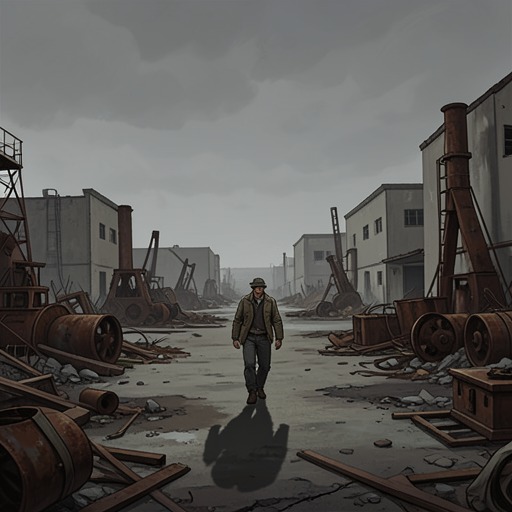
The factory stands beside the river and railway tracks, at the edge of a grassy floodplain where wild rose has swallowed a string of abandoned boxcars. A deer path leads through the meadow toward the buildings. From this open ground, the complex appears at once expansive and broken: the main plant is half collapsed, its bricks and wooden beams piled over old forges and hydraulic presses, while moss and vines grow through the wreckage. Rain makes the site more than a distant relic for travelers. Isaac and Billy are caught in it, and the exposed main building offers little protection.
The ruin belongs to a larger landscape of industrial contraction. For a century, the Valley had been a center of steel production; since Isaac and Billy were born, it had lost 150,000 jobs. Steelmaking had supported smaller businesses and industries, and the closure of the mills weakened that interconnected system along with the towns that depended on it. The book does not specify when the Standard Steel Car factory ceased operating, so its ruined condition is best read within this broader history rather than assigned an unsupported closure date.
Buildings, remnants, and reuse
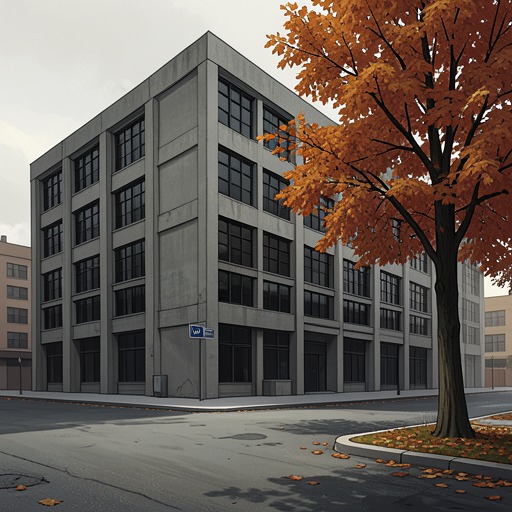
The main factory is vast, but the boys find a more sheltered structure nearby: a smaller brick building, about the size of a large garage, with boarded windows and an intact roof. Vines partly cover its exterior, yet a clear path through the grass leads to it. When Billy pushes its door, it opens without difficulty. Inside, the building’s former use is legible in the equipment left behind. It had been a machine shop, with lathes, milling machines, a gantry, and stands for grinding tool bits. Many portable parts are gone: the grinders, lathe chucks, and cross-feeds have been removed.
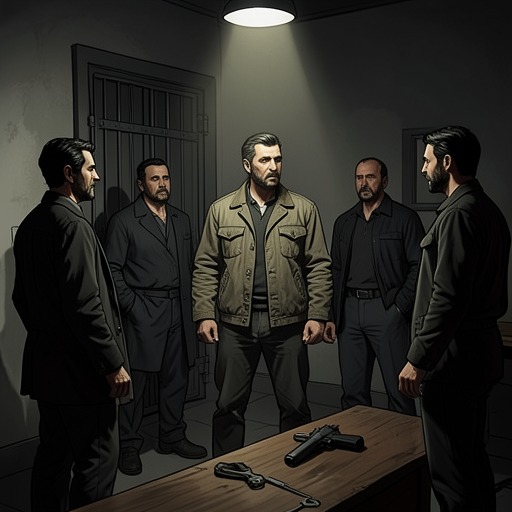
The room also bears traces of later occupants. Empty bottles and beer cans are scattered about, and an old woodstove and signs of recent fires suggest that people have used the shop as a place to shelter. That use is not organized or secure. When three men arrive with backpacks, the largest claims the spot as theirs. The encounter makes clear that abandonment has not made the factory empty; people still occupy and contest its spaces, even as the industrial purpose that once ordered them has disappeared.
The factory’s remnants also carry personal meaning. Isaac had pried a nameplate from a large hammer forge, polished and oiled it, and given it to Lee. She kept it over her desk. He thinks of the gift as a small act of rescue, preserving a piece of a once-proud workplace after the machinery and the work itself have largely vanished. The keepsake connects the industrial site to family memory without restoring what was lost.
The machine shop and the fatal encounter
The smaller building becomes the most consequential part of the complex. After the confrontation there that leaves Otto the Swede dead, Isaac and Billy return through the overgrown grounds. The familiar route has changed: grass is crushed, the ground is rutted with tire tracks, and an overgrown fire road has been churned into mud by vehicle traffic. From the hillside, they see Bud Harris’s truck near the site. The altered terrain registers the arrival of people and official attention, replacing the earlier impression of an obscure ruin where the boys could remain unseen.
As they move past the building, Isaac understands that Otto the Swede is no longer there and thinks the coroner and other authorities have probably already visited. The tracks and disturbed ground make the aftermath visible even before the boys reach the road. The factory is thus not simply a hiding place: its isolation helps the characters imagine escape, but its connections to roads, rail lines, and town authorities make that privacy temporary. The site holds the consequences of the confrontation in its altered ground and in the boys’ passage back through it.
Nature, memory, and narrative significance
Plants and wildlife repeatedly mark the factory as a place being reclaimed. Vines cover the main plant, moss grows among the collapsed structures, and wild rose conceals the boxcars. Deer paths cross the meadow; elsewhere in the abandoned industrial grounds of the Valley, deer and coyote tracks run through the remains. These details do not erase the factory’s history. They place natural growth alongside the physical evidence of production, abandonment, scavenging, and shelter, making the ruin an active landscape rather than a mere backdrop.
The site also concentrates the novel’s contrast between movement and entrapment. The railroad beside the floodplain offers Isaac a route toward Pittsburgh and, in his plans, California. Yet the boys’ return to the factory draws them back to the place tied to Otto the Swede’s death. The complex’s open, overgrown scale promises concealment, while the machine shop’s intimate remains carry the consequences of human violence. Through that tension, the Standard Steel Car factory links the Valley’s industrial decline to the characters’ immediate choices: a structure built for work becomes a shelter, a contested meeting place, and finally a landmark in an attempted escape.